
The Reserve Bank's rate-setting panel began its three-day deliberations on Monday to decide the next monetary policy amid expectations that the central bank will maintain status quo on the benchmark interest rate in the backdrop of global scare due to the new coronavirus variant Omicron. Reserve Bank Governor Shaktikanta Das headed six-member Monetary Policy Committee (MPC) is scheduled to announce the policy resolution on Wednesday. If the RBI maintains status quo in policy rates on Wednesday, it would be the ninth consecutive time since the rate remains unchanged.
The continuing global uncertainity has complicated the fight against inflation, opined Reserve Bank Deputy Governor Michael Debabrata Patra during the Monetary Policy Committee meeting held on February 8. According to the minutes of the MPC meeting released on Wednesday, RBI Governor Shaktikanta Das also mentioned that there is considerable uncertainty due to a host of global factors such as rising non-oil commodity prices. The RBI on February 8 hiked the key short-term lending rate by 25 basis points to 6.5 per cent, citing sticky core inflation.

Titan surged 2.98 per cent, followed by IndusInd Bank, ITC, JSW Steel, Infosys, Tech Mahindra, Tata Consultancy Services and Maruti. Hindustan Unilever, Asian Paints, Bharti Airtel and HDFC Bank were among the laggards.

The RBI, which had been following soft monetary policy since September last year to inject liquidity into the system to help industry combat the impact of the global meltdown, on Tuesday reversed its stance by increasing the SLR by one per cent to 25 per cent, though it kept other rates unchanged.

RBI may wait for a substantial downtrend and maintain repo at the current level in its third-quarter review.

While several key economic legislations, including insurance and PFRDA bills, are pending in Parliament, the government had to recently put on hold its decision to open the multi-brand retail sector to foreign investors.

'Data-dependence means you can raise or drop rates. The present stance is only for raising rates.'

The RBI has set up a panel to review ATM charges, and fees levied by banks.

The Reserve Bank's rate-setting panel, Monetary Policy Committee (MPC), began its three-day deliberations on Wednesday amid expectations of a status quo on benchmark rate mainly on account of uncertainty over the impact of the second wave of COVID-19 pandemic. Moreover, the fears of firming inflation may also refrain the MPC from tinkering with the interest rate in its bi-monthly monetary policy outcome to be announced on Friday. The RBI had kept key interest rates unchanged at the last MPC meeting held in April.
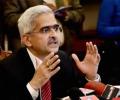
Amid prolonged uncertainty, continued policy support will be crucial for sustained economic recovery from the coronavirus pandemic, Reserve Bank Governor Shaktikanta Das said at the recent meeting of the Monetary Policy Committee. "In this period of prolonged uncertainty, it would be wise to remain agile and respond in a gradual, calibrated and well telegraphed manner to the emerging challenges," opined Das, according to the minutes of the MPC meeting released by the Reserve Bank on Thursday. Observing that economic recovery from the pandemic remains incomplete and uneven, he said, "continued support from various policies remains crucial for a sustained recovery." The governor said the renewed surge in international crude oil prices, however, requires close monitoring.

However, the economy expanded by 7.9 per cent in the second quarter from 6.1 per cent in the previous quarter, giving hopes of durable economic rebound.

'Whether I am optimistic or pessimistic is not the issue; I am just going by the evidence available.' 'The Indian economy and financial sector are now well-placed and very resilient in dealing with any kind of spillover coming from the external world.'
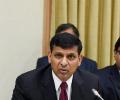
Reserve Bank of India (RBI) Governor Raghuram Rajan has set himself a target of lowering consumer inflation and is even ready to raise rates to achieve it, risking friction with the new government, if he is seen as overstepping.

RBI unsure whether to cut rates or not in its next monetary policy.

An article on 'State of the Economy' in the monthly Bulletin also said the improvement in the outlook for agriculture and the revival of rural spending have turned out to be the bright spots in the evolution of demand conditions. Consumer price inflation ticked up in June 2024 after three consecutive months of moderation as a broad flare-up in vegetable prices halted the overall disinflation that had been underway, it said.
At present, the repo rate acts as the policy rate when liquidity is in deficit mode while reverse repo becomes the operating rate when there liquidity is surplus.

The RBI has changed the way it approached supervision in the past. Having seen a couple of collapses in the NBFC sector and the near-collapse of a few banks, it is focusing on regular drills to prevent a fire from breaking out, explains Tamal Bandyopadhyay.

The Reserve Bank of India's (RBI's) record surplus transfer to the government has raised hopes among bond traders that the government might reduce its gross borrowing for the current financial year (2024-25/FY25) by up to Rs 1 trillion. The RBI approved a dividend of Rs 2.11 trillion for the central government for 2023-24, marking an increase of roughly 141 per cent from 2022-23 (FY23). In addition, the contingency risk buffer has been raised to 6.5 per cent from the previous 6 per cent.
The tenure of the committee will be for two years up to June 30, 2011, the central bank said. The panel will review the monetary developments in the country keeping in mind the macroeconomic scenario and will advise the banking regulator on the stance of monetary policy due on July 28.
Rs 5,000 crore additional liquidity facility to be provided by the National Housing Bank to boost liquidity in housing sector, the RBI said.

Equity benchmarks extended their decline for the fourth straight session on Wednesday, with the Sensex falling 214.85 points after the Reserve Bank raised the key interest rate by 50 basis points. Continuous foreign fund outflows and surging crude oil prices also weighed on markets. The 30-share BSE benchmark dropped 214.85 points or 0.39 per cent to settle at 54,892.49.

Bajaj Finance was the top gainer in the Sensex pack, rising around 4 per cent, followed by Maruti, SBI, Bajaj Finserv, Sun Pharma and Asian Paints. NSE Nifty rallied 293.05 points to 17,469.75.

Even as the high inflation figure for October has ruled out any possibility of a rate cut by the Reserve Bank of India's (RBI's) monetary policy committee (MPC) in December, a rate cut in February also looks uncertain due to global uncertainties. Economists told Business Standard that unless domestic growth slows markedly, the outlook on rate cut remains unclear. India's headline inflation touched a 14-month high of 6.2 per cent in October, breaching the MPC's upper tolerance band of 6 per cent.
For five consecutive policy reviews in 2023, the Reserve Bank of India (RBI) chose to hold rates, citing inflation threat. And when the prices did cool off a bit, it reminded all about the target to get the headline consumer price inflation at 4 per cent and the risks from food inflation. Heading into the new year, all eyes are on when RBI will cut the rates, especially after one of the Monetary Policy Committee (MPC) members stressed on the need for such an action in the face of the US Federal Reserve's guidance for easing rates.

The repo rate has been left unchanged at 4 per cent, Governor Shaktikanta Das said while announcing the decisions taken by the central bank's MPC.
Supporting Reserve Bank's hawkish stance on monetary policy, Finance Minister Pranab Mukherjee on Tuesday said the increase in the key rates was necessary to contain inflation.

The Nikkei Markit India Manufacturing Purchasing Managers' Index (PMI) -- an indicator of manufacturing activity -- declined from 52.5 in April to a three-month low of 51.6 in May.
The central bank's next monetary policy review is scheduled for April 5. It had kept the policy rate unchanged in its February meeting on fears of inflation.

Reserve Bank of India (RBI) Governor Sanjay Malhotra on Wednesday said regulations should not create unintended barriers to financial inclusion while emphasising that the impact of regulations on individuals and businesses should be considered.
.jpg)
The rate cut, the industry chambers argued, could have given a positive signal to the manufacturing sector, which is undergoing difficult times.
Professional forecasters have added to Reserve Bank of India Governor Duvvurri Subbarao's dilemma on timing the exit from an accommodative monetary policy stance.

'Although we are facing constraints related to lending and resource mobilisation, the government is aware of these.'
While the common citizen will benefit from the central bank's action, the policy stance is consistent with sustaining high growth in the medium term.

The impact of RBI's monetary policy on the Aam Aadmi of India is going to be minimal.

Das said banks have passed only 0.29 per cent in rate cuts to their borrowers as against 0.75 per cent cuts in interest rates by the Reserve Bank till June.

The policy guidance marks a clear shift in RBI's monetary policy stance towards addressing growth risks while not de-emphasising the objective of containing inflation
The Nifty added 87 points to end at 5,560.
Consumers may not have got any respite from high interest rates, but they also need not be apprehensive about further increase with the Reserve Bank of India giving a clear signal for stable monetary policy stance.

'Investors' decisions should reflect their financial goals, risk tolerance, and the amount of gold already present in their portfolio.'

The Reserve Bank of India's (RBI's) job to bring down inflation is not over, and any premature move on the policy front could undermine the success achieved so far on the price situation, according to RBI Governor Shaktikanta Das. RBI's rate setting panel, Monetary Policy Committee (MPC), had met for three days from February 6-8. The panel decided to leave the key policy rate unchanged at 6.5 per cent for the sixth time in row.
